 English
 Indonesian
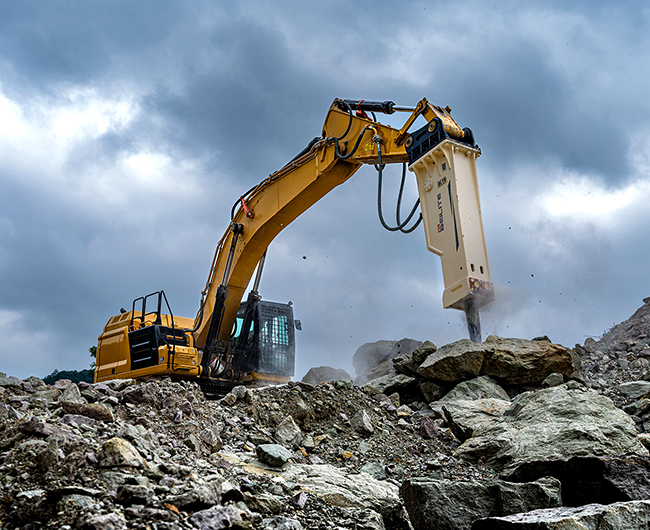
In today’s fast-advancement of infrastructure construction, demolition, quarrying, and mining industries, hydraulic hammers are the primary excavation attachments for modern construction. These hydraulic hammers, also known as hydraulic breakers, rock breakers, or hydraulic breaker hammers, have become some of the most essential tools for excavation and demolition. As the demand grows for higher efficiency, stronger performance, and more durable hydraulic hammers and demolition tools, hydraulic breakers are now used in a much wider range of complex environments, such as frozen region applications, high-temperature metallurgy engineering applications, mountainous regions, and more. Whether mounted on 1 to 20-ton mini excavators, wheel loaders, or 50 to 350-ton heavy-duty excavators, the hydraulic breaker machine has become indispensable in tasks involving rock fragmentation, concrete demolition, infrastructure repair, mining, and metal industry operations.
Most operators and constructors search for terms like “hammer near me”, “hydraulic hammer”, or “hydraulic breaker spare parts” to find the right excavation attachment for demolition tasks. It is also crucial to understand not only where these tools operate but also how they function, what their structural advantages are, and why they have become so dominant in modern engineering. Operators and constructors have many options for selecting the right attachment for excavation through our local dealers or via our official Beilite websites, including Beilite Indonesia and Beilite Saudi Arabia branches.
The Core Impact Power Energy of the Hydraulic Breaker Performance
A major reason for the widespread adoption of hydraulic breakers is their impact power and enhanced structural design. Through decades of innovation, manufacturers like Beilite Machinery now use optimized engineering concepts that dramatically improve striking power, durability, cost reduction, lifetime, and operational efficiency of hydraulic breakers.
Modern hydraulic hammers increase the stroke length of both the piston and the cylinder block. At the same time, they feature a large-diameter piston and an equally large-diameter chisel rod (or hammer tool). This synchronized design creates a seamless energy transfer path from the hydraulic system to the chisel tip, ensuring maximum striking force with each blow.
| BLTB-210 | 210mm | 60t-90t | 340-400 L/min | 280-300 bar | 90-120 bpm |
| BLTB-215 | 215mm | 65t-95t | 350-410 L/min | 280-300 bar | 90-120 bpm |
| BLTB-220 | 220mm | 70t-100t | 370-430 L/min | 300-330 bar | 80-110 bpm |
| BLTB-230 | 230mm | 75t-110t | 400-460 L/min | 300-330 bar | 80-110 bpm |
| BLTB-235 | 235mm | 75t-120t | 420-480 L/min | 300-330 bar | 80-110 bpm |
| BLTB-255 | 255mm | 90t-130t | 450-550 L/min | 300-330 bar | 70-100 bpm |
| BLTB-260 | 260mm | 90t-160t | 490-590 L/min | 300-330 bar | 70-100 bpm |
- Best compatibility between the hydraulic breaker and the host machines
- Rational and efficient use of hydraulic power
- Lower energy loss and higher output per blow
- Greatly enhance the work efficiency and reduce operating costs
Whether you are using a small hydraulic rock breaker for municipal projects or a high-impact hydraulic breaker hammer for mining, this optimized structure guarantees superior reliability.
Key Operating Environments for Hydraulic Breakers
Because of their versatility, hydraulic breakers are now used across a wide range of industries and environments. Below are the major operational fields where hydraulic hammers and rock breakers excel.
1. Highway Repair and Pavement Removal
One of the most common uses of hydraulic breakers is the removal of cement pavement on highways and bridges. Unlike traditional manual demolition tools, a hydraulic hammer can rapidly break thick concrete slabs, allowing construction teams to complete road repairs efficiently and with minimal traffic disruption.
2. Building Demolition and Reinforced Concrete Crushing
Hydraulic breakers are essential in urban demolition projects, where reinforced concrete, foundations, and building structures need to be removed quickly and safely. The precision of the hydraulic breaker hammer ensures controlled demolition without excessive vibration or collateral damage, a factor especially important in densely populated areas.
3. Municipal Projects and Landscaping Construction
In municipal engineering, hydraulic breaker machines are used for pipeline installation, old road reconstruction, landscaping projects, and underground utilities. Their ability to break rock and compacted soil makes them invaluable for trenching and site preparation.
4. Railway Tunnel Excavation and Mountain Blasting
“Opening mountains” for railway construction is another field where hydraulic rock breakers are indispensable. Before tunnel blasting, hydraulic hammers are used to remove unstable rock masses and clean tunnel faces. They also perform non-explosive excavation in areas where blasting is restricted.
5. Ship Hull Removal and Rust Cleaning
In shipyards, hydraulic breaker hammers are used for dismantling metal hulls, removing corroded steel plates, and conducting large-scale rust cleanup. Their concentrated impact energy makes them effective even on thick, hardened steel surfaces.
6. Metallurgical Industry and Furnace Dismantling
The metallurgical industry uses hydraulic breakers to clean furnaces, remove refractory bricks, dismantle smelting equipment, and break solidified slag. High-temperature-resistant hammer parts and hydraulic breaker spare parts ensure safe operation in harsh thermal environments.
7. Mining Exploration and Ore Crushing
Hydraulic breakers are widely used in open-pit mining, quarrying, and mineral processing. A hydraulic rock breaker can shatter oversized stones that cannot be moved or crushed by standard equipment, ensuring continuous workflow and improving production efficiency.
Understanding the Hydraulic Breaker Working Principle
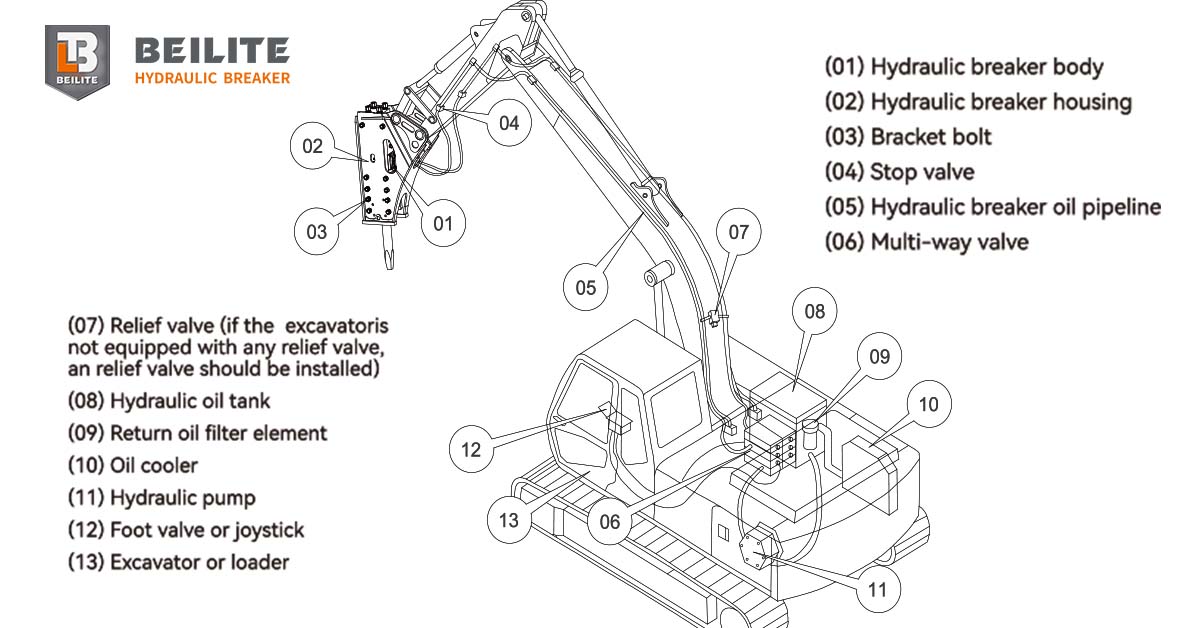
A hydraulic breaker operates by using hydraulic oil under high pressure to drive the piston inside the cylinder. The piston moves back and forth rapidly, striking the chisel or hammer tool with tremendous impact force. Each blow fractures and breaks down rock, concrete, or other hardened materials. At the same time, accumulators filled with nitrogen help store recoil energy and release it during the next strike, significantly increasing energy output while stabilizing operation.
Understanding the working principle of a hydraulic breaker enables operators to diagnose performance issues, select the correct hammer parts, and replace worn hydraulic breaker spare parts in a timely manner.
Choose the Right Hydraulic Breaker for Your Environment
Selecting the right hydraulic breaker requires considering the excavator model, working environment, material hardness, and required impact energy. Whether you are searching for a rock breaker attachment, or simply browsing for hammer parts and “hydraulic hammer near me” matching the breaker to your machine and jobsite is essential to achieving peak performance and long equipment life.
Beilite Machinery Co., Ltd.
40008-40008
info@beilite.com
+6282321982255