 English
 Indonesian
Hydraulic breakers or hydraulic hammer are robust piece of excavators equipment, but when a fault occurs, it can bring an entire demolition or excavation project to a halt. While many issues require professional intervention, but operators can take quick measures to diagnose and resolve some of the most common faults.
This guide is designed to empower operators with immediate troubleshooting steps, focusing on most frequency issues like no impact, decreased power, and excessive vibration. Basic knowledge about some common faults of hydraulic breakers can same time and money.
A Critical Warning: This information is to enable quick diagnosis. For internal malfunctions, damage, or complex circuit issues, do not attempt to self-repair. For example, case of Beilite Machinery hydraulic breaker faults modification, the company is not responsible for quality defects or damages resulting from unauthorized repairs. Always contact the official Beilite service network or certified service personnel for complex failures.
1. Why Hydraulic Breaker Does Not Work or No Impact?
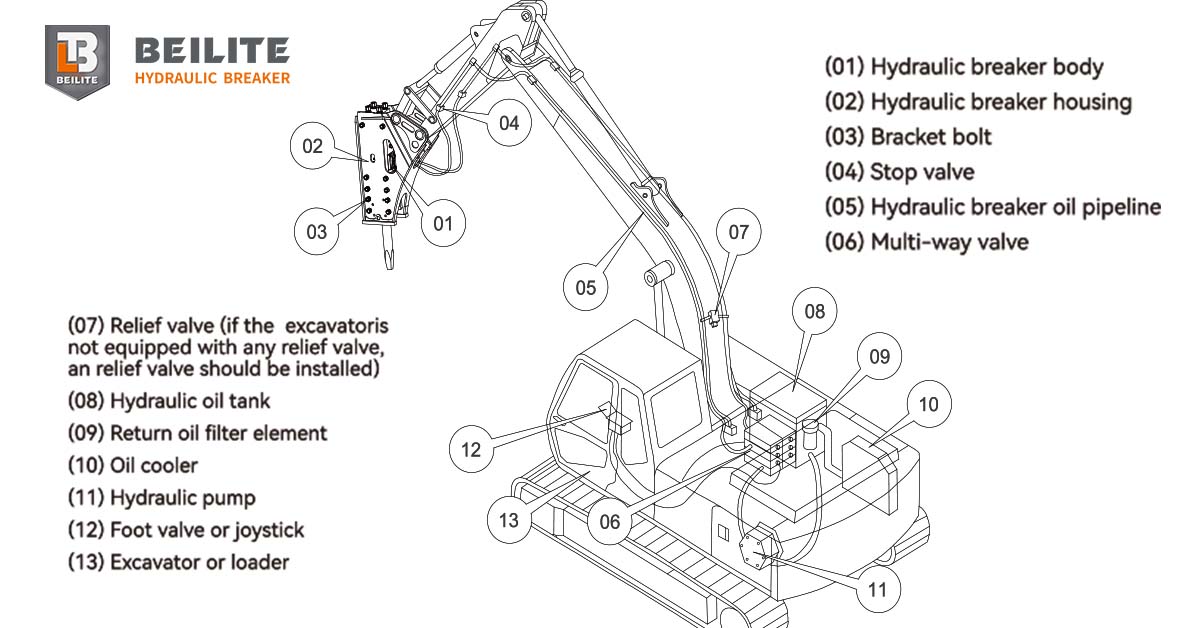
This is the most alarming failure. The cause is usually one of two things: a failure to supply high-pressure oil, or an internal circuit issue.
A. Hydraulic Rock Breaker High-Pressure Oil Cannot Be Supplied
Before assuming an internal fault, check the connection and supply basics:
| Cause (The Problem) | Simple Solution (Operator Fix) |
| Damage or blockage of stop valve | Confirm the stop valve on the forearm is fully open. |
| Reverse connection of high- and low-pressure hoses | Immediately exchange the connections between the high-pressure and low-pressure tubing. |
| Insufficient hydraulic oil supply | Check the oil tank level and replenish hydraulic oil. |
B. Why Hydraulic Rock Breaker High-Pressure Oil Can Be Supplied?
If the supply is confirmed but there is still no impact, the issue is more advanced:
| Cause (The Problem) | Simple Solution (Operator Fix) |
| Circuit system malfunction (switches/fuses) | Check the status of the switches and fuses on the main machine. |
| Nitrogen pressure of back head exceeds standard | Check the nitrogen pressure of the back head; adjust it if it is too high. |
| Breaker’s internal malfunction | Contact Beilite agent for assistance. |
2. Hydraulic Breakers Impact Power Decreases Obviously
The hammer breaker still strikes, but the force is noticeably weak. This often points to issues with pressure, oil quality, or the nitrogen charge.
| Cause (The Problem) | Simple Solution (Operator Fix) |
| Insufficient hydraulic oil supply | Check the oil tank and fill the hydraulic oil. |
| Contamination or functional decline of hydraulic oil | Check the oil tank and replace the hydraulic oil entirely. |
| Block of the excavator filter | Clean or replace the filter element on the excavator. |
| Nitrogen pressure in the back head is too low | Check the back-head pressure and adjust it to the standard range. If the problem persists after recharging, contact Beilite agent. |
| Functional decline of excavator hydraulic pump | Consult the excavator agent for repair. |
| Internal malfunction / Circuit block | Contact Beilite agent for assistance. |
3. Increased Vibration & Irregular Striking of Hydraulic Breaker
Excessive vibration coupled with decreased force is a strong indicator of low accumulator or back-head pressure, or a physical blockage.
A. Why Hydraulic Breaker Increased Vibration and Decreased Impact Force?
| Cause (The Problem) | Simple Solution (Operator Fix) |
| Low accumulator nitrogen pressure | Check the accumulator pressure and recharge to the specified range. |
| Low back head nitrogen pressure | Check the back-head pressure and adjust it to the standard range. |
| Unskilled operation | Park the excavator on hard ground, firmly fix the broken object, and then check performance. |
| Breaker’s piston cannot rise | Press the chisel downward continuously against hard ground in the vertical direction until the piston rises. |
| Breakage of chisel head | Uninstall the chisel and check if the head is broken or deformed. |
| Damage to accumulator parts / Adjuster valve | Contact Beilite agent for assistance. |
B. Hydraulic Breaker Irregular Striking Phenomenon
If the impact force is strong but the striking rhythm is erratic:
High Nitrogen Pressure: Check and adjust the back-head pressure to the standard range.
Unstable Hydraulic Pressure: This indicates a severe issue with the excavator’s hydraulic system contact Beilite agent for assistance.
4. Hydraulic Breakers Abnormal Temperature Rise and Low Impact Rates
As detailed in previous guides, hydraulic oil temperature is critical. A high temperature leads to low viscosity and poor performance.
| Fault (Low Impact Rate / Temperature Rise) | Cause | Simple Solution (Operator Fix) |
| Low Impact Rate | Hydraulic oil temperature increases (above 80°C (176°F) | Check the oil cooler system and allow the oil to cool |
| Low Impact Rate | Hydraulic oil temperature decreases (below 0°C) | Fully warm up the entire hydraulic circuit before starting operation |
| Abnormal Temperature Rise | Excavator cooler system malfunction | Use clean water to clean the radiator. If ineffective, consult the excavator agent |
| Abnormal Temperature Rise | Striking on extremely hard objects | Change the working position to an easier-to-break spot first |
| Low Impact Rate | High nitrogen pressure in back head | Check the back-head pressure and adjust it to the proper setting |
| Complex Faults | Back pressure on oil return line / Internal breaker fault | Contact Beilite agent for assistance |
Operators Must Check Hydraulic Breakers Components and Seal Kits for Safety Operations
When any fault occurs, always check these items first:
1. Stop Valve: Is it fully open?
2. Hydraulic Oil Level: Is the tank full?
3. Hose Connections: Are high- and low-pressure lines connected correctly?
4. Nitrogen Pressure: Is the back-head pressure within the standard range?
5. Chisel Condition: Is the chisel deformed or broken?
For any underlying issues related to hydraulic pump decline, control valve malfunction, or internal hammer breaker damage, prioritize contacting your authorized Beilite service network. Timely professional service is the best defense against catastrophic failure and costly downtime.
Frequently Asked Questions (FAQs)
1. What should I check immediately if my hydraulic rock breaker does not work (no impact)?
If your hydraulic rock breaker suddenly stops working, first check the basics related to oil supply:
Stop Valve: Confirm the stop valve on the forearm is fully open.
Hoses: Check the high and low-pressure hose connections to ensure they are not reversed.
Oil Level: Replenish hydraulic oil if the supply in the tank is insufficient.
Fuses: Check the switches and fuses on the main machine for any circuit malfunctions.
2. Why is my hydraulic hammer breaker striking weakly, even though it still moves?
Decreased impact power usually points to a pressure or oil quality issue. Common causes include:
Low Nitrogen Pressure: The back-head nitrogen pressure may be too low; check and adjust it to the standard range.
Contaminated Oil: The hydraulic oil may be contaminated or degraded, requiring replacement.
Filter Blockage: A blockage in the excavator filter can restrict flow; clean or replace the filter element.
3. What causes excessive vibration or irregular striking in a hydraulic breaker?
Excessive vibration often signals a problem with gas charge or physical contact:
Low Accumulator Pressure: Check the accumulator nitrogen pressure and recharge it to the correct level.
Low Back Head Pressure: Similar to the accumulator, low back-head pressure causes instability.
Piston Blockage: Ensure the breaker’s piston can rise. Pressing the chisel firmly downward against hard ground in a vertical direction can sometimes free a stuck piston.
4. When should I contact the service agent versus performing a self-fix?
You should only perform simple checks like confirming the stop valve position, checking oil levels, or adjusting the back-head nitrogen pressure. For any internal issues such as control valve malfunction, blockage of the hydraulic circuit, damage to accumulator parts, or any problem that persists after basic checks, you must immediately contact the Beilite agent or authorized service network.
5. Can cold weather affect the impact rate of a hydraulic breaker?
Yes, cold weather affects the impact rate. When the temperature is low, the hydraulic oil’s viscosity is high (too thick), which naturally causes a decrease in the impact rate. This is not a fault, but a characteristic. To compensate, ensure the hydraulic breaker and the excavator’s hydraulic system are fully warmed up before beginning operation.