 English
 Indonesian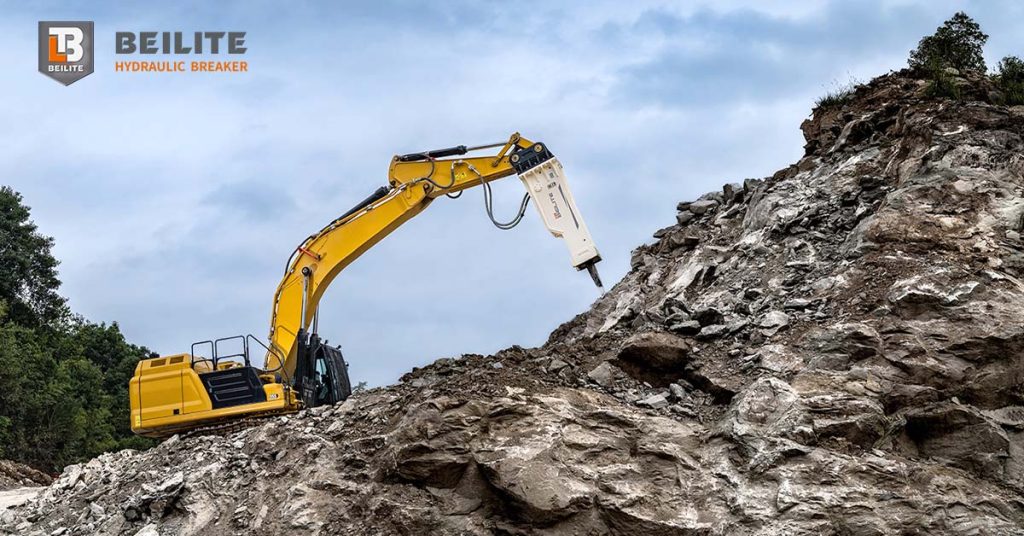
Medium hydraulic hammers are essential attachments for demolition, excavation, infrastructures construction, and mining projects. This comprehensive guide covers selection criteria, operation techniques, maintenance practices, and expert services to maximize your equipment’s performance and longevity.
How to Select a Medium Hydraulic Hammer?
Selecting the right medium hydraulic hammer requires careful consideration of several factors:
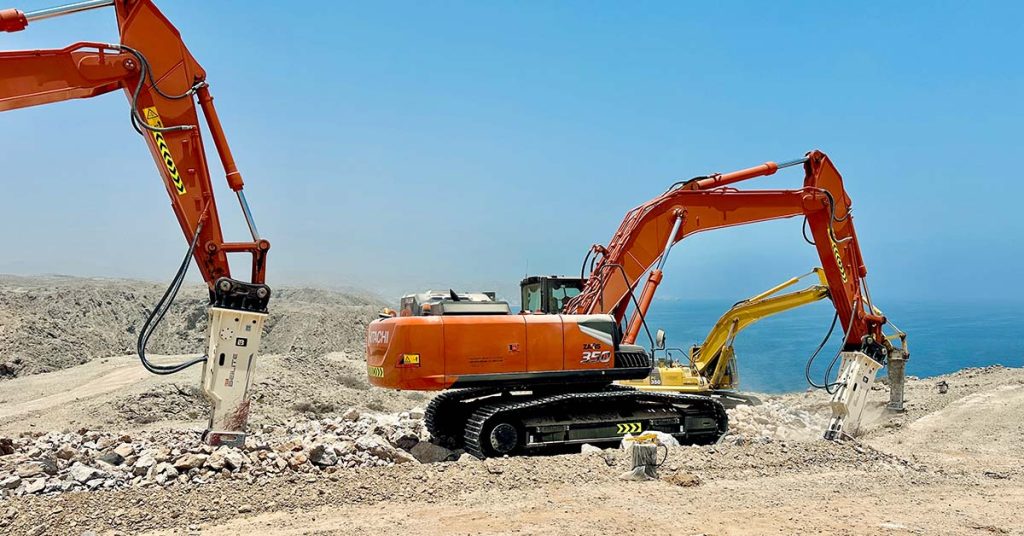
Weight and Power Requirements: Choose a hammer that matches your excavator’s weight class (typically 14-45 tons for medium excavators). The hammer should be 3-6% of the excavator’s operating weight for optimal performance.
Breaking Force: Evaluate the material hardness you’ll be working with. Medium hydraulic hammers typically deliver 2,250-15,000 joules of impact energy, suitable for concrete, asphalt, and medium-density rock.
Hydraulic Flow and Pressure: Ensure your excavator’s hydraulic system meets the hammer’s flow rate (90-240 liters/min) and pressure requirements (140-170 bar). Working flow, working pressure and impact rates should be between 90-120 liters/min, 150-170 bar, 350-650 bpm and 240-290 liters/min, 250-270 bar, 100-140 bpm respectively. Mismatched specifications lead to poor performance and premature wear.
Brand Reputation and Quality: Prioritize manufacturers with proven track records in hydraulic hammer technology, comprehensive warranties, and reliable after-sales support.
Table of Hydraulic Breakers that Match Excavators
| Model | Chisel | Suitable Excavator | Working Flow | Working Pressure | Impact Frequency |
| BLTB-125 | 125mm | 14t-18t | 90-120 L/min | 150-170 bar | 350-650 bpm |
| BLTB-135 | 135mm | 18t-22t | 100-150 L/min | 160-180 bar | 350-500 bpm |
| BLTB-140 | 140mm | 20t-24t | 120-180 L/min | 160-180 bar | 350-500 bpm |
| BLTB-150 | 150mm | 24t-27t | 130-190 L/min | 180-200 bar | 200-300 bpm |
| BLTB-155 | 155mm | 27t-33t | 180-240 L/min | 200-220 bar | 200-300 bpm |
| BLTB-165 | 165mm | 33t-38t | 200-260 L/min | 210-230 bar | 150-300 bpm |
| BLTB-175 | 175mm | 40t-45t | 220-270 L/min | 230-250 bar | 130-200 bpm |
| BLTB-185 | 190mm | 45t-55t | 240-290 L/min | 250-270 bar | 100-140 bpm |
Read More About How to Select Appropriate Hydraulic Breakers: Choose the Right Tool for Heavy-Duty Demolition
How Does a Medium Hydraulic Hammer Match Medium Excavator?
Proper matching between your hydraulic hammer and excavator ensures efficiency, safety, and equipment longevity:
Hydraulic Compatibility: Verify that the excavator’s hydraulic pump capacity matches the hammer’s flow requirements. Insufficient flow results in reduced impact frequency and breaking power.
Mounting Configuration: Ensure the hammer’s mounting bracket is compatible with your excavator’s arm specifications. Most medium excavators use pin-on or quick-coupler systems.
Weight Distribution: The hammer weight should not exceed the excavator’s lifting capacity at maximum reach. Improper weight balance causes structural stress and potential tipping hazards.
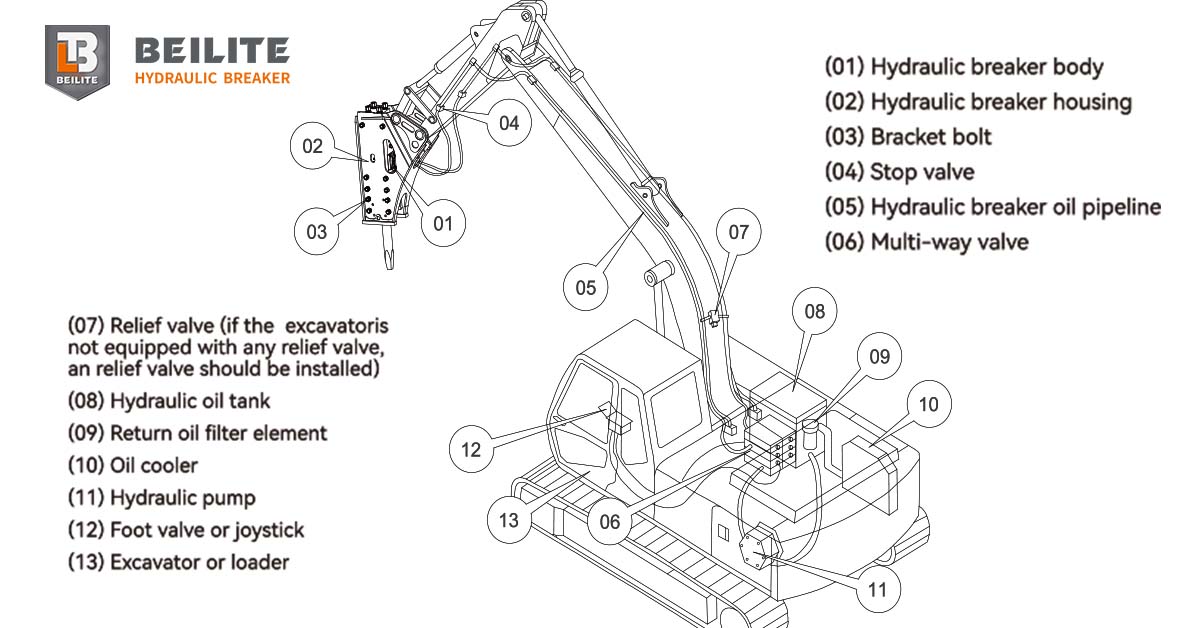
Auxiliary Hydraulic Circuit: Confirm your excavator has an auxiliary hydraulic circuit with proper controls. Some models require additional hydraulic lines and control valves for optimal hammer operation.
How to Operate a Medium Hydraulic Hammer for Excavator?
Safe and efficient operation maximizes productivity while minimizing equipment damage:
Pre-Operation Checks: Inspect all hydraulic connections, pins, chisel, piston, housing, seal kits, and mounting hardware. Check hydraulic oil levels and verify no leaks exist in the system.
Proper Positioning: Position the hammer perpendicular to the work surface for maximum breaking efficiency. Angled strikes reduce impact force and cause unnecessary wear on the chisel and bushing.
Operating Technique: Apply steady downward pressure without excessive force. Let the hammer’s weight and impact energy do the work. Avoid using the hammer as a pry bar or lever.
Blank Firing Prevention: Never operate the hammer without the chisel contacting material. Blank firing causes severe internal damage to the piston and cylinder walls.
Break Duration Management: Operate in intervals of 30-60 seconds, allowing the hammer to cool. Continuous operation leads to overheating and reduced component life.
Beilite Hydraulic Hammer for Excavator
Beilite hydraulic hammers represent cutting-edge technology in breaking and demolition equipment:
Advanced Engineering: Beilite hammers feature precision-engineered components with optimized energy transfer systems, delivering superior breaking force with reduced fuel consumption.
Durability Design: Manufactured with high-grade alloy steel and advanced heat treatment processes, Beilite hammers withstand extreme working conditions while maintaining consistent performance.
Model Range: The Beilite medium hydraulic hammer series offers models suitable for excavators from 14 to 45 tons, with impact energy ranging from 1,500 to 3,500 joules.
Carriers Matches: Beilite hydraulic hammers are match with all brand of carriers such excavators, backhoes, skid steers loaders etc. recognized all around the world.
Hydraulic Breakers Types: Beilite hammer breakers are categorized from mini, medium to premium heavy-duty demolition tasks (0.5tons to 350tons for excavators).
Quality Assurance: Each unit undergoes rigorous testing including pressure tests, impact frequency verification, and endurance trials to ensure reliability in demanding applications.
Read More About Beilite Hydraulic Breakers: Best Heavy Hydraulic Hammers for Excavators
Medium Hydraulic Hammer for Excavator Applications
Medium hydraulic hammers excel in diverse construction and demolition scenarios:
Concrete Demolition: Breaking reinforced concrete foundations, walls, and slabs in building demolition projects with precision and efficiency.
Road Construction: Removing asphalt pavement, breaking concrete roadbeds, and preparing surfaces for reconstruction in highway and municipal projects.
Rock Excavation: Breaking medium-density rock formations in quarrying, trenching, and foundation excavation where blasting is impractical or restricted.
Urban Renovation: Selective demolition in confined spaces where vibration control and noise reduction are critical considerations.
Utility Installation: Creating trenches for pipeline installation, breaking through rock layers, and preparing excavations for underground infrastructure.
Mining and Quarrying Applications
Medium hydraulic hammers are indispensable tools in mining and quarrying operations, offering efficient rock breaking solutions:
Primary Rock Breaking: Medium hydraulic hammers break oversize boulders and rock formations that are too large for crusher feed. They reduce material to manageable sizes without requiring expensive secondary blasting operations.
Secondary Breaking: In quarry operations, hydraulic hammers perform secondary breaking of extracted stone blocks, separating them into commercially viable sizes for processing and sale.
Bench Scaling: Remove loose and unstable rock from quarry faces and mining benches to ensure worker safety. Hydraulic hammers provide controlled removal without destabilizing surrounding formations.
Ore Extraction: Break through hard rock layers to access valuable ore deposits in underground and surface mining operations. The precision of hydraulic hammers minimizes ore loss and reduces processing costs.
Overburden Removal: Efficiently break through consolidated overburden materials including cemented gravels, weathered rock, and compacted clay layers that conventional excavation cannot handle.
Pit Floor Preparation: Level and prepare mine floor surfaces by breaking protruding rock formations, creating safe working platforms for heavy mining equipment.
Selective Mining: Target specific mineral veins or ore bodies with precision breaking that minimizes dilution from waste rock, improving overall ore grade and processing efficiency.
Cost Advantages: Hydraulic hammers reduce explosives consumption by 40-60%, eliminate drilling patterns for secondary blasting, and lower costs associated with blast monitoring and vibration control in sensitive areas.
Tunnel Profiling Applications
Tunnel profiling with medium hydraulic hammers ensures precise excavation contours and structural integrity:
Profile Trimming: After initial excavation by drill-and-blast or TBM methods, hydraulic hammers trim tunnel walls and crown to exact design specifications, ensuring proper clearances for final lining installation.
Over-break Correction: Remove protruding rock formations and irregular surfaces created during primary excavation. This prevents interference with tunnel lining systems and ensures uniform concrete thickness.
Rock Bolting Preparation: Create smooth, stable surfaces for rock bolt installation. Hydraulic hammers remove loose material and fracture zones that compromise anchor integrity and support system effectiveness.
Invert Excavation: Break and level tunnel floor sections to design grade, particularly in rock formations where conventional excavation methods are inefficient or impractical.
Cross-Passage Development: Excavate connecting passages between parallel tunnels in metro and railway projects, where space constraints and vibration limitations require controlled breaking methods.
Portal Preparation: Shape tunnel entrance and exit areas to precise specifications, integrating natural rock faces with engineered structures while maintaining slope stability.
Ventilation Shaft Profiling: Trim vertical and inclined shafts to design dimensions, ensuring proper airflow characteristics and structural requirements for ventilation systems.
Vibration Control: Unlike blasting methods, hydraulic hammers produce minimal ground vibration, making them ideal for tunneling beneath existing structures, railways, and urban infrastructure.
Safety Enhancements: Eliminate dangerous loose rock formations and unstable zones before workers enter newly excavated sections, significantly reducing rockfall hazards.
Precision Requirements: Modern tunnel projects demand tolerances within ±50mm. Hydraulic hammers enable operators to achieve these specifications while maintaining excavation rates of 15-35 m³ per hour depending on rock hardness.
Underground Construction Applications
Medium hydraulic hammers excel in diverse underground construction scenarios requiring precision and safety:
Cavern Excavation: Create underground chambers for water storage, fuel storage, and power generation facilities. Hydraulic hammers provide controlled excavation that preserves surrounding rock stability and minimizes support requirements.
Foundation Preparation: Break through rock layers for underground building foundations, parking structures, and basement excavations in urban areas where surface disruption must be minimized.
Utility Trenching: Excavate trenches for underground pipelines, electrical conduits, and telecommunications infrastructure through rock formations that resist conventional digging methods.
Shaft Sinking: Deepen vertical and inclined shafts for mine access, ventilation systems, and underground transportation infrastructure. Hydraulic hammers work efficiently in confined vertical spaces.
Station Excavation: Construct underground railway and metro stations by breaking rock formations with minimal vibration impact on surrounding structures and operational transit lines.
Drainage Systems: Create drainage galleries and sumps in underground facilities, breaking through impermeable rock layers to establish effective water management systems.
Underpinning Operations: Strengthen existing building foundations by excavating beneath structures to install new support systems. Hydraulic hammers provide controlled breaking that prevents settlement damage.
Rock Anchor Installation: Prepare anchor points and foundation zones in rock for structural support systems, retaining walls, and ground stabilization in underground projects.
Emergency Access Routes: Rapidly create escape routes and rescue access points in mining emergencies or tunnel incidents, where speed and safety are critical priorities.
Space Optimization: Work effectively in height-restricted environments typical of underground construction, with hammer designs accommodating ceiling clearances as low as 2.5 meters.
Environmental Advantages: Eliminate groundwater contamination risks associated with chemical breaking agents, reduce noise pollution in urban underground projects (80-95 dB compared to 110-120 dB for pneumatic methods), and minimize dust generation with integrated suppression systems.
Productivity Metrics: In competent rock formations, medium hydraulic hammers achieve excavation rates of 8-35 m³ per hour for tunnel profiling and 12-35 m³ per hour for cavern enlargement, significantly outperforming manual methods while maintaining precise dimensional control.
Hydraulic Hammer for Complex Environments
Operating in challenging conditions requires specialized considerations:
Underwater Applications: Some medium hydraulic hammers feature sealed designs for submerged operations in marine construction, bridge pier demolition, and underwater pipeline work.
High-Altitude Projects: Equipment modifications for reduced atmospheric pressure ensure consistent performance in mountain construction and mining operations above 3,500 meters.
Extreme Temperature Environments: Special hydraulic oils and sealing materials maintain functionality in temperatures ranging from -30°C to +50°C.
Confined Spaces: Compact hammer designs with reduced length enable operation in tunnels, basements, and areas with limited overhead clearance.
Dust and Debris Management: Integrated dust suppression systems and protective covers minimize environmental impact in sensitive urban areas.
Benefits of Medium Hydraulic Hammer for Excavator
Investing in quality medium hydraulic hammers attachments delivers substantial advantages:
Increased Productivity: Breaking speeds 3-5 times faster than manual methods significantly reduce project timelines and labor costs.
Versatility: Quick-change chisel systems allow rapid adaptation to different materials—from asphalt to reinforced concrete—without equipment changes.
Cost Efficiency: Eliminates expenses associated with alternative breaking methods such as chemical demolition agents or specialized drilling equipment.
Precision Control: Operators achieve selective demolition with minimal damage to surrounding structures, crucial in renovation and retrofit projects.
Reduced Environmental Impact: Lower noise levels compared to pneumatic hammers and elimination of explosive materials make hydraulic hammers ideal for urban construction.
Enhanced Safety: Controlled breaking reduces hazards associated with manual demolition methods and unpredictable material fracturing.
Maintenance of Medium Hydraulic Hammer for Excavator
Systematic maintenance extends equipment life and ensures consistent performance:
Daily Maintenance: Inspect chisel condition and replace if worn beyond 70% of original length. Check all mounting bolts for tightness. Lubricate chisel and bushing with appropriate grease every 2-5 hours of operation.
Weekly Maintenance: Examine hydraulic hoses for wear, cracks, or leaks. Verify nitrogen gas pressure in the accumulator (typically 8-12 bar when not operating). Clean external surfaces to prevent debris accumulation.
Monthly Maintenance: Replace hydraulic oil filters and inspect oil quality for contamination. Check internal components for wear if performance degradation is noticed. Verify all safety features function correctly.
Annual Maintenance: Conduct comprehensive internal inspection including piston, cylinder, and seal condition. Replace worn seals and gaskets. Professional servicing by certified technicians ensures thorough evaluation.
Record Keeping: Maintain detailed logs of operating hours, maintenance performed, and parts replaced to predict component lifecycles and plan preventive maintenance.
Spare Parts of Medium Hydraulic Hammer for Excavator
Maintaining adequate spare parts inventory minimizes downtime:
Critical Wear Parts: Chisels (pointed, flat, blunt), bushings, and retaining pins require regular replacement based on material hardness and operating hours.
Hydraulic Components: Seal kits, piston assemblies, and accumulator diaphragms should be stocked for rapid replacement during scheduled maintenance.
Structural Components: Side bolts, through bolts, and mounting pins are essential for maintaining structural integrity and proper operation.
OEM vs. Aftermarket: Original Equipment Manufacturer (OEM) parts guarantee compatibility and performance, while quality aftermarket alternatives offer cost savings with acceptable durability.
Parts Availability: Establish relationships with reliable suppliers offering expedited shipping. Consider stocking high-wear items for immediate replacement to avoid project delays.
Beilite Customer & Operator Services
Comprehensive support services maximize your investment:
Training Programs: Professional operator training covers safe operation techniques, maintenance procedures, and troubleshooting common issues to enhance productivity and equipment longevity.
Technical Support: 24/7 hotline assistance from experienced technicians provides immediate solutions to operational challenges and emergency breakdowns.
On-Site Service: Mobile service units deliver repairs, maintenance, and inspections at your job site, minimizing transportation costs and downtime.
Warranty Coverage: Extended warranty options protect your investment with coverage for major components, hydraulic systems, and manufacturing defects.
Consultation Services: Expert assessment of your specific application requirements ensures optimal equipment selection and configuration for maximum efficiency.
Parts Distribution Network: Strategically located distribution centers ensure rapid parts delivery, reducing equipment downtime and maintaining project schedules.
Technical Assistant Availability: Beilite hydraulic breakers manufacturer assistance technic team is available 24/4 hotline. If you need any assistant contact immediately.
Conclusion
Selecting and operating a medium hydraulic hammer requires understanding equipment specifications, proper matching with your excavator, skilled operation techniques, and diligent maintenance practices. By following these guidelines and partnering with reputable manufacturers like Beilite, you’ll achieve optimal breaking performance, extended equipment life, and improved project profitability. Invest in quality equipment, prioritize operator training, and maintain comprehensive service relationships to maximize your hydraulic hammer’s value across diverse applications and challenging environments, hydraulic breaker for sale, hydraulic breaker attachments, hydraulic breakers for backhoes, hammer breaker for skid teers loader。
Keywords :
Medium hydraulic hammers, hydraulic hammers, hydraulic hammer technology, Auxiliary Hydraulic Circuit, hydraulic oil levels, Beilite hammers, Beilite hydraulic breakers, Mini excavator hydraulic hammers, Hydraulic Breakers Types, hydraulic hammers trim tunnel walls, hydraulic hammers attachments, OEM vs. Aftermarket, rock hammer,
FAQs
Q1: How do I know if my excavator is compatible with a medium hydraulic hammer?
Check three key factors: (1) Your excavator’s weight class should be 14-45 tons, with the hammer weighing 3-6% of the excavator’s operating weight; (2) Verify your hydraulic system provides 90-290 liters/min flow rate and 140-270 bar pressure; (3) Ensure you have an auxiliary hydraulic circuit with proper controls. Mismatched specifications lead to poor performance and equipment damage.
Q2: What are the most common maintenance requirements for medium hydraulic hammers?
Daily maintenance includes inspecting chisel wear, checking mounting bolts, and lubricating the chisel and bushing every 2-5 hours. Weekly tasks involve examining hydraulic hoses and verifying nitrogen gas pressure (8-12 bar). Monthly maintenance requires replacing hydraulic oil filters and inspecting components. Replace chisels when worn beyond 70% of original length to maintain breaking efficiency.
Q3: What applications are medium hydraulic hammers best suited for?
Medium hydraulic hammers or rock hammers excel in concrete demolition, road construction, rock excavation, mining and quarrying, tunnel profiling, and underground construction. They efficiently break reinforced concrete, asphalt, medium-density rock, and perform precise excavation in confined spaces. With impact energy of 1,500-3,500 joules, they’re ideal for projects requiring controlled breaking with minimal vibration in urban environments and sensitive areas.
Beilite Machinery Co., Ltd.
40008-40008
info@beilite.com
+6282321982255